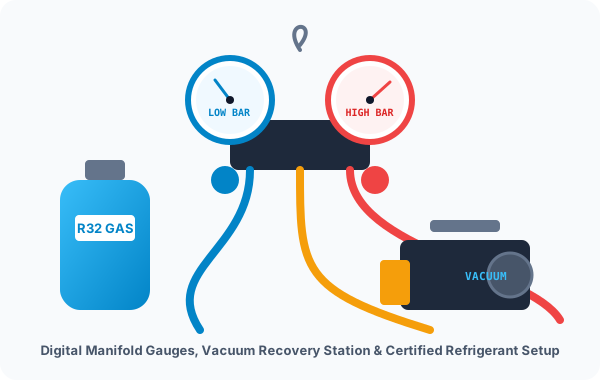
The Thermodynamics of AC Gas in the Maltese Climate
Refrigerant is the thermodynamic working fluid that carries heat from inside your home and dumps it outside. In Malta, where ambient roof temperatures reach 45°C to 50°C during peak summer, the refrigerant undergoes extreme compression and temperature cycling:
- R32 Refrigerant: A modern single-component difluoromethane hydrofluorocarbon (HFC) with a Global Warming Potential (GWP) of 675. R32 operates at elevated pressures (125–145 PSI suction, 380–450 PSI discharge in Maltese summer) and provides roughly 10% higher thermodynamic efficiency than R410A. Because it is a single component, it does not suffer from glide or fractionation when leaks occur.
- R410A Refrigerant: A near-azeotropic 50/50 blend of R32 and R125. When an R410A system leaks slowly over time, the more volatile R32 leaks out at a faster rate than the R125 (a phenomenon known as fractionation). To restore factory cooling performance after a substantial leak, the remaining off-ratio blend must be professionally recovered and replaced with virgin refrigerant charged exclusively in liquid phase.
- Phased-Out R22 Gas: Banned completely across the European Union due to ozone depletion properties. Systems utilizing R22 cannot be legally recharged; they must be retrofitted with drop-in replacements like R422D or replaced with high-efficiency R32 inverter units.
Why "Topping Up" Without Repairing Leaks Fails
Uncertified handymen often offer cheap "gas top-ups" that temporarily cool a room for two weeks before the gas escapes again. This practice causes severe mechanical damage:
- Compressor Lubrication Starvation: Synthetic polyolester (POE) refrigeration oil is miscible in refrigerant. As gas leaks out, atomized oil escapes with it, coating the surrounding area in an oily film. Running a gas-starved system strips the compressor scroll of lubrication, leading to metal-on-metal friction and mechanical seizure.
- Atmospheric Moisture Contamination: When refrigerant pressure drops below atmospheric pressure on the suction side, humid Maltese ambient air is drawn into the copper circuit. Moisture reacts with POE oil to form hydrofluoric acid, which eats away motor winding varnish and causes terminal short circuits.
- Legal F-Gas Compliance: EU Regulation (EU) 517/2014 and Maltese environmental legislation mandate that an active leak must be repaired and verified with a pressure decay test before any refrigerant can be introduced.
Our 6-Step Certified Refrigerant Recharge Procedure
- Electronic Sniffer & Ultrasonic Leak Audit: We scan all copper flare connections, service valve caps, and U-bends using heated diode electronic detectors capable of detecting leaks as small as 3 grams per year.
- Environmentally Compliant Gas Recovery: Remaining contaminated refrigerant is extracted into dedicated recovery cylinders using an oil-less recovery unit.
- Permanent Mechanical Repair: We cut cracked copper pipe ends, re-flare using precision eccentric flaring tools, apply Nylog blue gasket sealant to flare faces, and torque brass flare nuts to exact manufacturer Newton-meter (Nm) specifications.
- High-Pressure Nitrogen Pressure Decay Test: The sealed circuit is charged with Oxygen-Free Nitrogen (OFN) to 35 bar (500 PSI) and monitored for 30 minutes to verify zero pressure drop.
- Deep Vacuum Dehydration: A two-stage rotary vane vacuum pump evacuates the lines down below 500 microns to boil off and extract all internal moisture.
- Electronic Scale Weigh-In: Virgin refrigerant is weighed into the liquid line using calibrated digital electronic scales accurate to within ±2 grams according to the outdoor unit data plate.
Refrigerant Comparison: R32 vs R410A vs R22
| Refrigerant Property | R32 (Modern Standard) | R410A (Established Inverter) | R22 (Banned Legacy) |
|---|---|---|---|
| Chemical Composition | Single Component (CH2F2) | 50% R32 / 50% R125 blend | Single Component (CHClF2) |
| Global Warming Potential (GWP) | 675 (Low) | 2,088 (High) | 1,810 (High + Ozone Depleting) |
| Typical Suction Pressure (35°C Ambient) | 125 – 140 PSI | 115 – 130 PSI | 65 – 75 PSI |
| Typical Discharge Pressure (35°C Ambient) | 380 – 440 PSI | 370 – 430 PSI | 240 – 275 PSI |
| Fractionation Risk on Leakage | Zero (Can be topped up) | Moderate (R32 leaks faster) | Zero (Banned from recharging) |
| Legal Status in Malta / EU | Fully Approved (Standard) | Phasedown in progress | Strictly Prohibited |
Transparent Gas Refill & Leak Repair Pricing
| Service Item | Scope of Service | Fixed Rate (EUR) |
|---|---|---|
| Electronic Leak Detection Audit | Sniffer detection, bubble solution testing, service valve check | €45.00 |
| Flare Joint Cut, Re-Flare & Torque | Precision mechanical repair of defective copper flare joint | €55.00 – €75.00 |
| Nitrogen Pressure Test & Deep Vacuum | 35 bar pressure decay test + deep evacuation < 500 microns | €45.00 |
| R32 Full Gas Recharge (Up to 1.0 kg) | Virgin R32 weighed in with digital scale (9k – 12k BTU unit) | €65.00 |
| R410A Full Gas Recharge (Up to 1.2 kg) | Virgin R410A liquid-phase charging (9k – 12k BTU unit) | €75.00 |
| Additional Refrigerant per 100g | Over 1.2 kg capacity (large 18k–24k BTU or long pipe runs) | €8.00 / 100g |
Frequently Asked Questions About AC Gas Refill Malta
The most common symptoms include the indoor unit blowing room-temperature or barely cool air, frost or ice forming on the thin liquid copper pipe at the outdoor unit, an oily residue around pipe connections, or the system shutting down after 10 to 15 minutes with a low-pressure error code.
No. Recharging a leaking system without repairing the leak is illegal under EU F-Gas regulations and wastes your money, as the newly added gas will escape within days or weeks. Our technicians always locate and repair the leak before adding refrigerant.
In Malta, the primary causes are thermal expansion loosening brass flare nuts on rooftop outdoor units, vibrations from high-wind Mediterranean storms flexing copper pipe bends, and saline sea mist corroding aluminum U-bends on outdoor condenser coils.
No, never. Although both operate at similar pressures, R32 is mildly flammable (A2L safety classification) and requires spark-proof electrical components, different oil specifications, and specific compressor designs. Charging R32 into an R410A system creates severe safety and mechanical hazards.
In a properly installed system with leak-free flare connections and silver-brazed joints, the factory refrigerant charge lasts for the entire operational life of the unit (12 to 15+ years) without requiring any top-ups.
Service Coverage Throughout Malta
We provide fast mobile dispatch to Valletta, Sliema, St Julian's, Birkirkara, Mosta, Qormi, Naxxar, San Gwann, Mellieha, Bugibba, Marsaskala, and Gozo Island.
Speak Directly with a Certified Technician
Need quick troubleshooting or an honest upfront quote? Our team is on call across Malta.