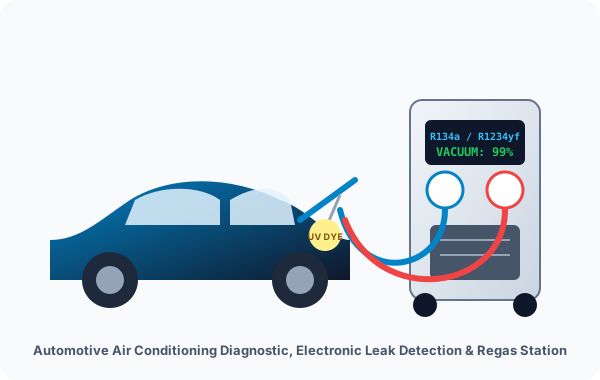
Why Automotive Air Conditioning Systems Fail
Unlike domestic split systems that remain stationary on walls, vehicle air conditioning systems are subject to constant motion, severe road vibrations, engine heat, and abrasive road debris. Operating under these conditions leads to distinct mechanical failure modes:
- Thermal Expansion Joint Leaks: Aluminum refrigeration lines expand and contract at different rates from the steel vehicle chassis. Rubber O-rings connecting pipe joints harden and crack over 4 to 6 years, resulting in slow refrigerant leakage.
- Compressor Reed Valve Failure: Liquid refrigerant slugging—caused by an overcharged system or failed expansion valve—can bend or fracture the thin spring-steel reed valves inside the compressor pistons, destroying pumping efficiency.
- Receiver-Drier Desiccant Saturation: The receiver-drier contains molecular sieve desiccant pellets to absorb internal moisture. Once saturated, moisture combines with refrigerant to form corrosive hydrofluoric and hydrochloric acids that pit aluminum tubing from the inside out.
Methodical Auto Aircon Diagnostic Protocol
- Electronic Pressure & Temperature Diagnostic: Testing low-side and high-side operating pressures to calculate system superheat and subcooling.
- Electronic Halogen Leak Detection: Scanning high-risk areas including condenser welds, compressor body seals, and expansion valve fittings with an electronic sniffer.
- Compressor Electrical Circuit Inspection: Checking power and ground feeds, testing the 12V electromagnetic clutch coil, and verifying high-pressure safety cutout switch continuity.
- Deep Vacuum Hold Test: Evacuating the system for 30 minutes to verify vacuum hold stability and eliminate all internal moisture.
- Weighed Refrigerant & PAG Oil Recharge: Refilling factory-specified refrigerant weight down to the gram and replenishing synthetic PAG lubricant.
Car Aircon Diagnostic & Troubleshooting Guide
| Symptom | Root Cause | Testing Method | Corrective Action |
|---|---|---|---|
| Air blows cool initially, then turns warm | Low gas causing evaporator freeze-up | Observe suction pipe frosting under hood | Locate leak, repair O-rings, vacuum & recharge |
| AC compressor does not engage at all | Pressure switch tripped due to zero gas | Static pressure reading < 20 PSI | Nitrogen pressure test, seal leak, regas system |
| Clicking sound from under dashboard | Stripped gears in heater blend door actuator | Listen to dash while cycling temperature control | Replace motorized blend door actuator unit |
| Water pooling on passenger footwell floor | Blocked evaporator condensate drain tube | Inspect rubber drain grommet through firewall | Clear rubber drain tube and sanitize evaporator box |
Standard Car Aircon Repair Pricing
| Service Category | Procedures Included | Cost Range (EUR) |
|---|---|---|
| Standard R134a Regas & Vacuum | Recovery, 25-min vacuum, oil top-up, UV dye, full gas | €65.00 – €85.00 |
| Modern R1234yf Regas Service | Dedicated R1234yf recovery, vacuum test, exact gram fill | €130.00 – €180.00 |
| AC O-Ring Seal Replacement | Disassembly of leaking joints, new HNBR green O-rings | €45.00 – €75.00 |
| Cabin Decontamination & Pollen Filter | Antibacterial ozone mist + new carbon cabin filter | €45.00 – €65.00 |
Frequently Asked Questions About Car Aircon Repair
The evaporator coil removes moisture from the cabin air, which drains outside via a rubber tube through the firewall. If this drain tube becomes blocked with dust and mold, condensate backs up and overflows into the passenger footwell. Clearing the drain tube solves the problem.
External issues such as a worn magnetic clutch, failed pulley bearing, or defective electronic control valve (ECV) can easily be repaired or replaced without replacing the entire compressor. However, if the internal pistons or swashplate have seized, the complete compressor must be replaced and the lines flushed.
The best preventative measure is to run your AC for at least 10 minutes every couple of weeks throughout the winter. This circulates the PAG oil, keeping rubber seals and compressor shaft gaskets lubricated so they do not dry out and leak.
R134a has a Global Warming Potential (GWP) of 1,430. Under European environmental regulations, all new cars manufactured since 2017 must use R1234yf, which has a GWP of less than 1. R1234yf requires specialized charging equipment and dedicated recovery machines.
Standard diagnostics and regassing take about 45 to 60 minutes. Component replacements, such as swapping an accessible front condenser or blower motor, typically take 2 to 3 hours.
Service Coverage Throughout Malta
We provide fast mobile dispatch to Valletta, Sliema, St Julian's, Birkirkara, Mosta, Qormi, Naxxar, San Gwann, Mellieha, Bugibba, Marsaskala, and Gozo Island.
Speak Directly with a Certified Technician
Need quick troubleshooting or an honest upfront quote? Our team is on call across Malta.